Picture hyperlinked to website. |
 |
|||
In 1740, due to conflict, diseased climates, and the various British colonists rejections, the Moravians were forced north (Thomas, 1994). In going North, the Moravians established the towns of Bethlehem, Pennsylvania and Nazareth, Pennsylvania (Rauschenberg, 1995). With a growing population, and religious desires, the town decided to set out on a new mission to find the next settlement in the name of the Moravian Church. Through this settlement, the church would finally be able to create a utopian society in which they could practice their beliefs, and create a town based upon the ideals of the Moravian Church (Thomas, 1995). On August 25th, 1752, an elected party of five men left Bethlehem, Pennsylvania to set out for the perfect sect of land to establish their community. The five men consisted of Bishop Spangenberg, Timothy Horsefield, Joseph Miller, Herman Loesch, John Merk and Henry Antes (Clewell, 1902, p. 6). The five men set out, destined for North Carolina where the Lord’s Proprietor was selling out land (Rauschenberg, 1995; Martin 2012). The journey took somewhere around thirteen days, and was made up of traveling both by land and water (Clewell, 1902 p.6). On September the 10th, the five men arrived in Edenton and stayed under the care of Francis Corbin, the Agent of Lord Granville. After resting for a week, and experiencing two with extreme illness, the men set out with the exceptions of Miller and Horsefield who remained in Edenton sick with Malaria. Both Miller and Horsefield later returned to Pennsylvania, but did not rejoin the group on their survey of the land (Clewell, 1902, p. 6). In statements throughout their journals, the men faced interesting experiences throughout their survey of North Carolina. Apart from illness, they ate corn with Tuscarora Indians, found no land among the various trade routes; suffered from a severe snowstorm in the Blue Ridge Mountains; found themselves lost along the way; followed their compass back to established civilization; and finally found themselves directed towards the land known as “the three forks of Muddy Creek,” otherwise known today as the Yadkin River (Fries, 1949, p. 5). On December 27, the date of their arrival at Muddy Creek, their were fourteen sections of the land surveyed, combining to a total of seventy-three thousand acres (Clewell, 1902, p. 9). Seeing that the land was good and beneficial to the colony, Bishop Spangenberg returned to Pennsylvania and began negotiating for the land. On August 7th, 1753, nineteen deeds totaling 981,985 thousand acres (roughly one hundred thousand), was granted to the Moravians (Rauschenberg, 1995, p. xxii). With the purchase of such a large area of land being so expensive, the land was financed through an “especially organized land company” (Fries, 1949, p. 6). Through viewing the illustrious beauty of the rolling lands, and hills, Spangenberg suggested the name of Der Wachau for this tract of land, in honor of the estate of Count Zinzendorf (Fries, 1949, p. 6-7; Martin 2012). Der Wachau is the name used when speaking in the German language, however when speaking in English settlers preferred to use the Latin version of the name entitling the community Wachovia (Fries, 1949, p. 7; Martin 2012). In going to establish the land of Wachovia, it was decided that a team of men, particularly who were single, with various talents and skills would go to establish a colony. After all, the new settlement would need individuals representing various talents in order to establish a strong colony. The new settlement would consist of a minister, a physician, a business man, men of other various trades, as well as two farmers (Clewell, 1902, p. 13-14). The following below are a list of the men who went to establish a village in which they could bring others down from Pennsylvania.
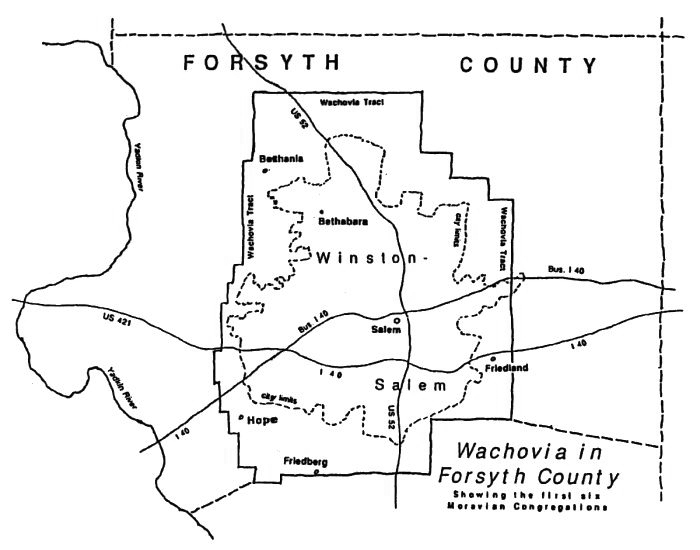
In congruence with these twelve, followed three brethren by the names of Gottlob Koenigsderfer, Nathaniel Seidel, and Joseph Haberland (Clewell, 1902, p. 14). These men left their colony of Bethlehem, October 8th, 1753, following a route that was almost a direct line in Wachovia (Clewell, 1902, p.15). After a long, stressful journey the men finally entered into the borders of Wachovia a little after noon, on November 17th, 1753 (Clewell, 1902, p.18). The men set their path to reach their cabin in which the fifteen of them would be staying. From staying here, they founded one of the towns and named it Bethabara. Soon to follow would be the founding of Salem in the mid 1760’s as well as the towns of Bethania, Friedland, Friedberg, and Hope (Clewell, 1902, p.15; Winston-Salem and Forsyth County, n.d.). |
||||
